Showing posts with label technology. Show all posts
Thursday, September 1, 2011
Human categorization via social media
I'd like to thank Facebook for making it so easy to fit my life into various pre-defined categories: education, music preferences, favorite athletes, things I "like." It's nice to see political views taken so seriously as an option as well. Facebook is, after all, an extension of ourselves, and that freedom of expression is not to be trifled with, no sir. Especially if you're tired of being nice to people who don't give a shit. Sign me up for that one.
And apparently drunken twats don't know the proper usage of the various forms of "your." Go figure.
Monday, July 25, 2011
The Blackberry Suicides
Let me tell you a story. It is one of loss, betrayal, and first-world hardship. This is a story that proves it may, in fact, be better never to have loved than to have loved and lost. This is the chronicle of my pathetic history with the Blackberry.
I bought my first Blackberry in the summer of 2009 as a personal reward for completing college and obtaining a real-person job. It felt appropriate: I was an adult, and people would thus require constant access to me. In turn, I would need constant access to Google maps, Facebook, and the TFLN mobile website. I even bought a gel skin to protect my investment. Life was grand.
The following Thanksgiving, I was helping my grandfather haul a Christmas tree over a porch railing, forgetting about my prize Blackberry encased in its feeble gel skin in my front pocket. I leaned hard, resulting in a broken screen. Goodbye, Blackberry #1.
Blackberry #2 fell victim to a friend's birthday bar night in Kenosha, Wisconsin, a few months later. It was left on a table, whereupon some douchebag picked it up, turned it off, and probably sold it on eBay, instead of replying to my frantic texts and phone calls. People are a-holes.
Blackberry #3 also fell victim to a broken screen, but I was particularly irked because I hadn't done anything to deserve it this time. It was just sitting in my bag, minding its own business, when it got the living shit kicked out of it by another member of my purse community. No one has stepped forward to claim responsibility. It was probably domestic terrorism.
Blackberry #4 was lost in epic fashion while vacationing in Las Vegas this past February. To protect the integrity of those involved, I'll just say that the last time I saw it, my fourth Blackberry was somewhere in Treasure Island. (Trust me, it's not the weirdest thing found there.) Needless to say, Vegas marketers don't fuck around.

At this point, my cell phone insurance provider dropped my coverage. I was officially on my own. But that didn't slow my irreverent momentum, as Blackberries were dropping like acid at a Flaming Lips concert. Blackberry #5 was in my hand during a softball team bar outing this spring. Fifteen minutes later, it was nowhere to be seen. Again, I suspect some douchebag picked it up and made an eBay profit. Seriously, people suck.
Blackberry #6 was obtained from the T-Mobile store in June, but within a couple days it was clear there was a defect that prevented certain necessary actions. I could not, for instance, upload photos to Facebook from my mobile device. Finding this injustice unacceptable, I took it back to the store and traded it for one that worked. This, I submit, was the most innocent and painless of the Blackberry deaths. At the very least, it was definitely not my fault.
But Blackberry #7 only lasted two weeks. It was lost this past Thursday, somewhere between a River North club and the cab ride home. I honest to God have no idea what happened.
The cosmic message is clear: I was not meant to be a smartphone owner. In an act of contrition, I've downgraded to the "Samsung :)" -- a slide phone designed for a 13-year-old girl with an emoticon fetish. If I can keep this flimsy not-smartphone alive for a year, I'm allowed to get another Blackberry. We'll see how it goes.
In the meantime, I urge you, dear Reader, to observe a moment of silence for the seven Blackberries that had to die to teach me this unpleasant lesson. What was meant to be a symbol of my triumphant entry into adulthood has turned into the insolent shitshow of my early twenties. Let their demise not be in vain. Learn from my tale. And don't bother with the gel skin.
Tuesday, April 26, 2011
Wikipedia Burn
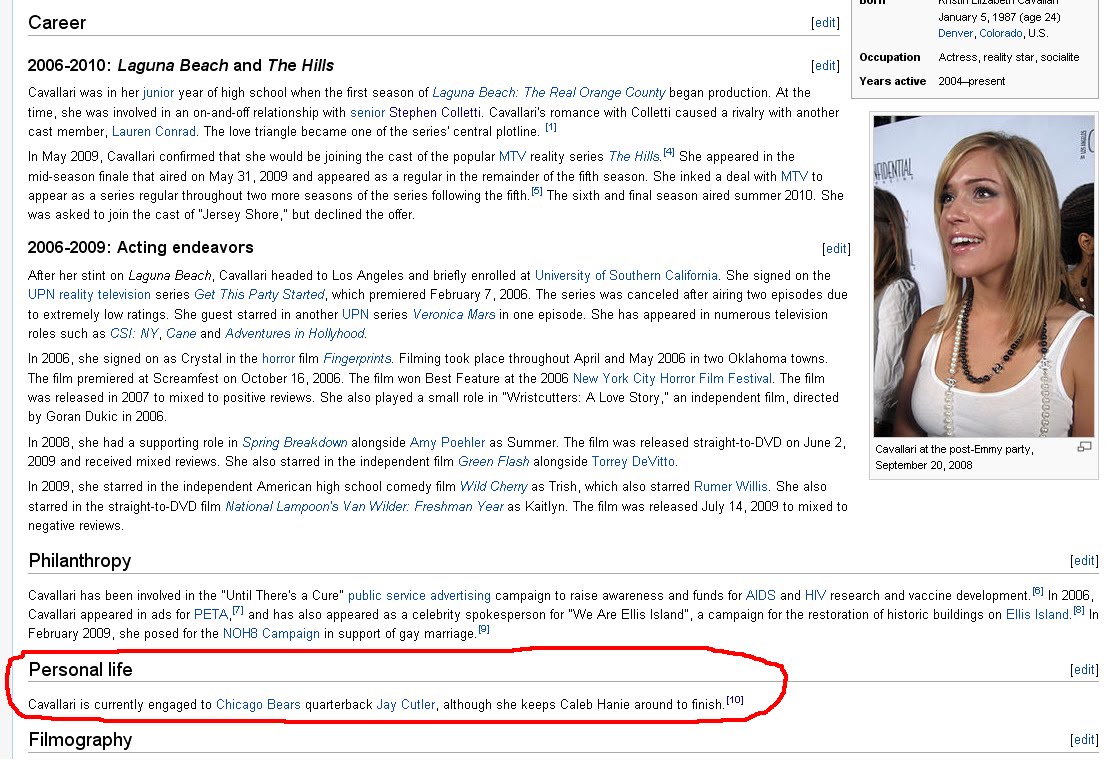
Last night, Bears Quarterback Jay Cutler proposed to girlfriend and "actress" Kristin Cavallari. The news is already on Wikipedia, and I'd like to thank the anonymous editor for putting it bluntly. Who says you can't use Wikipedia as a source of absolute truth?
Monday, April 18, 2011
How far can I take meta if I blog about Scre4m?
I'm not a big horror movie fan. My roommate is, and so I find myself stumbling into a Saturday afternoon viewing of a slasher flick with more regularity than ever before. It's pleasant; just yesterday we watched Crispin Glover slice up the standard set of collegians in a forest somewhere. (The most memorable thing from that one was his strange, backwoods hick accent.)
Despite my lack of enthusiasm for the genre in general, I have always been a huge fan of the Scream movies. The second and third installments lacked a bit of the bravado and originality of the first, but I loved the concept. They're horror films made for the horror film nerds. Though I am not a horror film nerd, per se, I am a nerd in other ways, and I dig the self-referential nature of the movies. The humor in the recognition of parody makes the gruesome death scenes worth it, and the archetypal characters are designed to allow you to see the fun in human death -- not an easy feat when considered objectively. Why the hell do we enjoy watching people killed on film? That's sick, people. Just sick.
That said, I was totally on board when Scre4m was announced. The first Scream movie came out in 1996 and spent approximately seven years on a recorded VHS tape in my room, watched and rewound an average of twice a month for the duration. So hell yes we were going to Scre4m on opening weekend. It would be like a return to childhood. A classic formulaic plotline, executed perfectly. (I have an admittedly eager/gushy opinion of Wes Craven.)
So tonight my friend Shara and I went to see it and I'll tell you, dear Reader, we were not disappointed. Scre4m is a masterpiece. It may even be better than the first movie, but that may be because now the franchise is such a powerhouse in the genre -- in Hollywood in general -- that it can afford the most impressive cast including originals Neve Campbell, Courteney Cox and David Arquette as well as bit roles for the pseudo-famous and modern hot young actresses Anna Paquin, Kristen Bell, Hayden Panettiere, and Emma Roberts. The big budget nature, which usually kills horror movies because they're blown so out of proportion (providing material for the decidedly less witty and more base-humor-dependent Scary Movie series), is instead spent on making the newest Scream sequel the perfect archetype. It's like Wes Craven is actually attempting to make the exact model on which we should base all future horror movies. He does everything right -- tension-building, semi-memorable characters whose deaths don't break our hearts, and breaking the rules that are set up within the structure of the movie to glorious effect. (The scene with Kristen Bell and Anna Paquin is, by far, my very favorite. I mean, shit you guys. It's genius.)
Seeing Scre4m in a theater on a Sunday night felt like being back in high school. The bored and haggard concessions kid, the trendy urbanites spending their parents' money on candy and video games, the groups of freshly driver's-licensed teens walking in pods of five or more. And of course, the archetypal, self-referential horror movie, where we watch characters do exactly what we're doing right now. It's all about killing the horror film nerds who are sitting there, watching a horror movie. Holy crap that's us you guys!!!! SO META.
And there's the heart of the matter. The great thing about the 2011 version that may push it beyond the 1996 original is the presence today of the word to describe this entire phenomenon: meta. Courteney Cox's character even uses the term in the movie, tacking on a line about how it's "what the kids are calling it" or something like that. Urban Dictionary defines "meta" as such, and gives an example:
"A term, especially in art, used to characterize something that is characteristically self-referential."
"So I just saw this film about these people making a movie, and the movie they were making was about the film industry..."
"Dude, that's so meta. Stop before my brain explodes."
It's like the concept and this horror franchise were made for each other. And the use of technology -- cell phones, texting, even live web streaming -- is perfectly in line with how this generation is living. No one was tweeting the Woodsboro murders in this one, but it's a safe bet that will be integrated into the script for Number Five."Dude, that's so meta. Stop before my brain explodes."
The films are scary, as one of the characters points out, because it could happen. The audience are the potential victims. There's even a scene in Scre4m where a bunch of teenagers throw a party knowing that it's a likely target for the killer because that's what comes next in the horror film stereotype: a bloodbath at a party. You don't have to be a bad person in order to be killed by a psychopath, the movies tell us -- you just have to have the bad luck to attend the same high school or live in the same town. Of course you can help your situation if you remain a virgin. And don't run up the stairs when running out the front door is even an option. It's common sense, people.
As soon as this movie about horror movie fans being slaughtered was complete, Shara and I laughed about the fact that we had to go into a dark parking garage -- something that doesn't go so well for one of the characters in the movie we'd just seen. As I dropped her off a block away from her apartment, I wished her a safe walk -- not out of the ordinary for midnight on a busy street in Chicago, but with a bit more paranoia on the edge of my voice. I drove home alone, car doors locked, mulling over the movie and deciding how to best describe why I'd enjoyed it so much.
I parked my car behind my building and walked up the stairs to the back door of my third floor apartment, scanning my surroundings as I took out my keys. I'm always taken aback when I see a neighbor on their porch or something I don't notice right away, but no one was out. I realized then that I was missing the key that opened the back door. I stood there in the dark, shuffling around in my pockets, not wanting to wake up my roommates but feeling, you know, a bit on edge. Time to not be outside anymore. But I was locked out. What great timing, my grim imagination said.
Luckily my roommate was awake to let me in. I went straight to my computer to overshare my life on social media, as my generation is wont to do, first on Facebook and then on my blog. I'm not normally one to write reviews, but this felt right. It felt meta. I mean, the point of these Scream movies is to take the suspense to the next level, and the chosen vehicle is this millennial concept. It's original because it breaks new ground and scares us in the exact same way it's always scared us, but we still didn't see it coming. We're outsmarted, and it's one of the rare times that feels good. By writing about it, I become part of the story.
It's successful because you can't walk out of that movie and not see the potential for your own situation to suddenly turn into your own fatality. It's haunting. As I sit in my room typing this, it's raining outside. Middle of the night. My door is cracked so my cat doesn't wake me up when she tries to get in at 3am. It also means someone could enter my room silently. I locked the back door and found my key. It's actually sort of comforting to talk to the world via my blog like this though. With all this meta, horror-movie-watchers-being-killed-stuff flying around in my brain, at least you guys know I haven't been murd
Friday, April 8, 2011
The Power of YouTube
As you read this, YouTube is shaping the future of the music industry. Somewhere, sitting on a Disney bedspread and munching on some brand of neon, processed American "nourishment," there is a seven-year-old child surfing YouTube and dreaming of being a rock star.
The 'Tube is taking place of the tube.
It's certainly not news that we're turning away from television and toward the Internet -- but how will that affect the iconic musicians of The Future? There are exponentially more resources available to each new generation. Can you imagine if Jimi Hendrix had lived in the '00s? (Or even past age 27?)
For the sake of The Future -- that is, the amorphous but finite stretch of time ahead until we club the planet over its metaphorical head and drag it into the depths of hell, summarily wiping out the human race (all inevitable) -- I hope the kids in the footie pajamas are idolizing guys like Jack White.
We're due for some new prodigies soon. And Justin Bieber definitely doesn't count.
On a personal note, it appears my Weezer era is drawing to a close, in favor of my blues rock era. Don't worry, Rivers. I'll be back.
The 'Tube is taking place of the tube.
It's certainly not news that we're turning away from television and toward the Internet -- but how will that affect the iconic musicians of The Future? There are exponentially more resources available to each new generation. Can you imagine if Jimi Hendrix had lived in the '00s? (Or even past age 27?)
For the sake of The Future -- that is, the amorphous but finite stretch of time ahead until we club the planet over its metaphorical head and drag it into the depths of hell, summarily wiping out the human race (all inevitable) -- I hope the kids in the footie pajamas are idolizing guys like Jack White.
We're due for some new prodigies soon. And Justin Bieber definitely doesn't count.
On a personal note, it appears my Weezer era is drawing to a close, in favor of my blues rock era. Don't worry, Rivers. I'll be back.
Tuesday, March 15, 2011
@MayorEmanuel's Twitter Picaresque

The story's a few weeks old now, but The Atlantic published the most complete and impressive piece on the @MayorEmanuel phenomenon of the last few months. They also happened to break the identity of the Twitter feed's owner -- Punk Planet founder Dan Sinker.
The entire article is worth the read, but what really sets it apart is the analysis of how Sinker used Twitter to create a whole new method of storytelling. Atlantic editor Alexis Madrigal compares the 1,942 tweets (about 30,000 words) to a real-time picaresque novel, noting how the immediacy of the content allowed the reader to experience the raw composing process: "Writing happens in fits and starts, so the finished product should look that way, too. And that's the thing, with a Twitter narrative, your lines come stamped with a time and the kind of software used to send the message. You can't conceal the process of writing, so you have to learn to love that transparency."
Twitter was the only place this could have happened. We'll talk about @MayorEmanuel for awhile, but those who didn't experience it first-hand, as it was unfolding, won't have the same visceral attachment. Madrigal again: "@MayorEmanuel is a new genre that is native to Twitter. When you try to turn his adventures into traditional short stories or poems, they lose the crucial element of time. The episode where the mayor gets stuck in the sewer pipes of City Hall just does not work when the 15 tweets aren't spaced out over 7 hours. It's all over too fast to be satisfying. There's no suspense." It was that real-time storyline that made @MayorEmanuel not just a funny side story to the election, but a revolutionary discovery in modern storytelling.
At the end of the article, Madrigal posts some of the "goodbye" tweets from @MayorEmanuel's many fans, and one expresses pity for those who weren't there to experience the phenomenon: "@ourmaninchicago: I genuinely feel sorry for anyone who didn't watch @MayorEmanuel unfold." The sentiment, no doubt, is widely shared, and indicative of the uncharted frontier we've found. The experience was surreal, a chance to watch (along with tens of thousands of others) a real-time fiction manifest itself in one Firefox tab, while the other tabs were tuned to reality. Everything was linked, everything was happening at once, and we all watched it together. I'd even go so far as to say that @MayorEmanuel had a positive influence on the Chicago mayoral election by focusing more attention on it, particularly in regards to young people. It was amusement, but it also served a public service.
Twitter can create a forum to watch a brand new, incredibly engaging form of storytelling -- a type of writing that is truly contained in the 21st century. It is a formula that can without doubt be recreated. Now the question is...who will write the next great Twitter picaresque?
Wednesday, March 2, 2011
Girl Talk: A New Live Music Frontier
I WANT TO BE THERE.
I come from a family of concert-goers. When I was a kid, my mom met my stepdad while following the Grateful Dead on tour. As a pre-teen, I made a conscious decision to attend my first "real" concert at Carver-Hawkeye Arena in Iowa City. And I have to tell you, the Backstreet Boys rocked my world that night. I was in 12-year-old heaven. There's nothing better than live music, even if it is pop and partially lip-synced.
(I saw the Backstreet Boys again last summer at Ravinia. Everyone there was female, aged 20 to 35. It was a joyous reunion of my original music community.)
But not many acts patronized Iowa City or Hilo, so it wasn't until I moved to Chicago for college that I had access to the good stuff. Mad Caddies, Pepper, The Decemberists, Reel Big Fish, Maroon 5, My Chemical Romance, Keller Williams, blues clubs -- my tastes cover the spectrum. I took a break from live shows after college; they're expensive, and a bunch of my concert buddies had moved away. My triumphant return was marked by my first Weezer show in January and a single weekend in February that featured both The Decemberists and Keller Williams. But this Friday I embark on a genuine first: I'm seeing Girl Talk.
If you're unfamiliar with Gregg Gillis, aka Girl Talk, allow me to educate you:
The first track off "All Day," the most recent Girl Talk release (November 2010).
He's probably the most famous DJ* touring today, and his specialty is mashing up music -- everything from current pop to gangsta rap to Elton John to the Jackson 5. In performance, he mixes tracks live, so no two shows are the same. He's been called a lawsuit waiting to happen -- technically he doesn't have permission to use the copyrighted music clips -- but he releases his albums for free and asks people to pay whatever they want, citing fair use. And despite criticism, he's gotten away with it for 10 years, two EPs and five full-length albums. (Check them out here.)
What makes this guy amazing is the way he rehabilitates songs we've long since forgotten. For instance, if you never thought L'il Mama and Metallica made fit bedfellows, you've never listened to "Like This" off 2008's Feed the Animals:
Oh yeah, and Mya can come too.
One of my rare regrets from undergrad is skipping the show he played at our student center in 2008. I plan to set the universe right this Friday when my friend Christina and I see him live at the Congress. I expect nothing less than a life-changing experience.
When it comes to live shows, I'm all about preparation. Enjoy with me.
Tuesday, February 22, 2011
The (Twitter) Discourse
We talk in education classes about a "discourse," or the idea that a community creates its own tailored language, complete with standard conventions, jargon, even inside jokes. Every group has a discourse: academia, Chicago south side urbanites, Big Island locals, Wall Street veterans, junior high science teachers, even the Northwestern University Marching Band, to name a few. Each group speaks a lexicon that is understood by its members, often to the exclusion of outsiders. (NUMB makes a rather strong case, actually.)
One of the goals of education, specifically when teaching writing, is to introduce students to many different kinds of discourses. The hope is that we go beyond what the student already knows and literally expand their world by showing them the lenses belonging to people who are different from them. Usually this begins with the simple task of making sure everyone is on the same page with standard English -- and often that's where we sputter. A communication barrier exists between a student and a teacher that cannot speak the same language, or cannot recognize what creates the differences. That's where creative and compassionate teaching comes in.
But there is so much to teach. We want students of language to appreciate the many ways that language is used, from stuffy academic journals to newspaper articles to cryptic blogs to Facebook wall posts to grocery lists. We want them to know why and how all of this content is created and used; who's doing it and for what reasons. Literacy -- fluency in a discourse -- cannot exist without that understanding of audience, purpose and especially subject.
My latest attempt at learning a new discourse is Twitter. I was familiar with the basic premise -- 140 character max, the concept and usage of the "re-tweet," even the many opportunities for #hashtaghumor. As a n00b of the discourse, I've tread carefully -- I don't want to look silly in front of my new pals, or new connections to old pals. I've learned that pushing the "re-tweet" button, for example, does not allow you to add your own comment; to do so, you have to copy-paste, throw in an @[source of original Tweet], and so forth. These things become natural to us the more we participate in a given discourse. In no time, I'll be throwing hash tags around like nobody's business, holding inherently disjointed conversations with my fellow Tweeters (Twitterers? Twitters? Twits? I still have things to learn).
The hardest part, really, is taking the leap and attempting to join a new community. The learning curve can be intimidating, the fear of failure or embarrassment paralyzing. It's one of the reasons that it's so hard to get students unfamiliar with the academic discourse to trust that they can handle the material. If the community they come from doesn't value canonical authors, the likelihood that the student will care about James Joyce or Shakespeare is pretty much nil. They're irrelevant, even trivial, in the practical life of the student. And it's hard to learn a new discourse -- there's always the fear of not passing, of your peers and teachers seeing through your act and knowing you're a phony.
I finally understand why some of my teachers were so great, and some so disappointing.
This non-traditional, five-paragraph (plus a stinger) essay brought to you by almost 20 years of sometimes great, sometimes terrible, sometimes public, sometimes private, often dull, always under-funded schooling.
Tuesday, February 15, 2011
Caving to the Twitterverse
I was working as an intern at PC Magazine when Twitter really took hold of the media in 2007. Almost everyone around me that was hip and technologically savvy -- so, you know, pretty much everyone at Ziff Davis -- jumped on the bandwagon. I did not.
I was a naysayer, a non-believer. Everything was moving too fast for me to keep up. It was a trend, a fad, a way for narcissists to project more of themselves into the world, regardless of whether we want to read about their every thought or breakfast decision. It'd go away once people realized that it was basically useless, a haven for the self-obsessed. Does this sound familiar?
Well, I underestimated American society. And, also, I was wrong.
Twitter is a great tool, particularly for a journalist. Writers spend the time we aren't writing wondering whether anyone is reading what we're writing, and scheming new ways to catch new and more eyes, to create some reverberation in the massive expanse of the media void. It operates on the same premise as Facebook in that it's completely composed of what people put into it of themselves. And what we've put into it -- breaking news, pop culture, cupcake trucks -- is astounding. Twitter may have started as an overshare device, but it's becoming a cultural necessity.
As I embark on a concerted effort to get published more regularly as a freelance writer, my plan is to use Twitter as a professional resource, an RSS feed of links and (hopefully coherent, relevant and engaging) thoughts. I will forever be overshadowed by Kanye West, but hey, follow me @britpetersen. I could use the company.
Friday, February 11, 2011
Steve Heminover, Mad Scientist
Last spring I got a chance to interview a really interesting guy named Steve Heminover who happens to do the light shows for all the sports events at the United Center. The fruits of that adventure are below. Enjoy!
Steve Heminover flips on a light switch in the control box and motions me to a chair overlooking the ice. He turns on a computer that looks like it belongs in a NASA cockpit and drums his fingers on the table. Windows start-up chimes and after a quick test to make sure his half-a-million-dollar equipment is working properly, he starts the show. Four green aerial lasers shoot upward from the corners of the arena. A laser animation of Benny the Bulls mascot is projected onto the floor.
“It’s more impressive with the music,” he says apologetically. Indeed, Bulls fans might overlook the lasers with everything else going on during the opening – scoreboard videos, blasting music, dancing Luvabulls. The United Center is the only arena in the country with a permanent laser installation, and Heminover has been running the shows at Blackhawks and Bulls games for more than fourteen years.
“Have you ever played with an Etch A Sketch?” Heminover asks. “It’s like that but the computer does it so fast. It turns the beam on and off, changes the color, and it has to move it around and all these things have to coordinate at once to make it work.” The end result is a laser animation that represents decades of innovation.
Pre-game laser show during a packed Bulls game at the United Center. Photo courtesy of Steve Heminover.
Fifty-six-year-old Heminover has been working with lasers for so long that he’s helped build the foundation for the entire industry. “When I started in the laser business, nobody had any tools to do what I wanted to do,” he says. “So I had to invent them. I literally wrote, from scratch, my own graphics language for doing lasers.” That language is the ancestor to modern stereoscopy and 3-D technology. If you saw Avatar in 3-D, you can thank Heminover for helping to lay the groundwork.
“I used to wonder when I was growing up why I could do all these things,” Heminover says. “And I realized that what comes easy to me doesn’t come easy to other people. These things are gifts. I mean, I can work in several disciplines. To do laser light shows that I’ve done for years, I have to be an electrician, I have to be a plumber, I have to be a contractor, I have to be an artist, I have to be an engineer, I have to be a safety guy.”
In 1987, Heminover pulled his various talents together to found a multimedia company, Aura Technologies Inc., which specializes in finding creative solutions to technological problems. The company has designed instant-replay boxes for the Major League Baseball, fiberoptics for Motorola, and electronic packaging for Leo Burnett Worldwide ad agency.
“Someday you’ll see a cereal box with a video game on the front,” Heminover says. “You’ll just throw it away when you’re done.”
Heminover seems to live and dream in a futuristic movie. His office is decorated with Star Trek and Star Wars posters. His cell phone ring is a Jetsons jingle. He even looks vaguely like George Lucas. The geekiness pays off; with thirty years of experience in electrical and design engineering, it’s guys like Heminover that continually invent the things we couldn’t even conceive of ten years earlier.
“What did Arthur C. Clarke say?” he asks, eyes twinkling behind wire-rimmed glasses. “'Any technology, sufficiently advanced, will seem like magic.'” Whether it’s the rise of the Internet or 3-D printing, Heminover is always on the lookout for the next frontier. Lasers are just his day job.
At the United Center, my personal laser show is coming to a close. Before he shuts down the system, Heminover says there’s one more feature that is reserved for “special guests.”
“You’ll like this,” he says with a sly smile. “And they say we don’t have a sense of humor.”
He boots up software that came pre-loaded on the laser system. A faint “Pew! Pew!” sound emits from the control room speakers as the 50-by-50-foot grid lights up with the opening screen of one of the world’s most recognizable video games.
“You play Asteroids on the ice of the United Center?”
Heminover starts to answer, but the urgency of fragging a 30-foot laser rock distracts him. He hands me the controls to the world’s most expensive video game and asks, “You got another quarter?”
Steve Heminover, Mad Scientist
The United Center is deserted. The building hums and the smell of stale beer lingers in the air. It’s eerie, cavernous. Yesterday, 22,000 spectators watched the Chicago Blackhawks defeat the Vancouver Canucks in Game 2 of the Western Conference Semifinal series. But tonight, we have the place to ourselves.Steve Heminover flips on a light switch in the control box and motions me to a chair overlooking the ice. He turns on a computer that looks like it belongs in a NASA cockpit and drums his fingers on the table. Windows start-up chimes and after a quick test to make sure his half-a-million-dollar equipment is working properly, he starts the show. Four green aerial lasers shoot upward from the corners of the arena. A laser animation of Benny the Bulls mascot is projected onto the floor.
“It’s more impressive with the music,” he says apologetically. Indeed, Bulls fans might overlook the lasers with everything else going on during the opening – scoreboard videos, blasting music, dancing Luvabulls. The United Center is the only arena in the country with a permanent laser installation, and Heminover has been running the shows at Blackhawks and Bulls games for more than fourteen years.
“Have you ever played with an Etch A Sketch?” Heminover asks. “It’s like that but the computer does it so fast. It turns the beam on and off, changes the color, and it has to move it around and all these things have to coordinate at once to make it work.” The end result is a laser animation that represents decades of innovation.
Fifty-six-year-old Heminover has been working with lasers for so long that he’s helped build the foundation for the entire industry. “When I started in the laser business, nobody had any tools to do what I wanted to do,” he says. “So I had to invent them. I literally wrote, from scratch, my own graphics language for doing lasers.” That language is the ancestor to modern stereoscopy and 3-D technology. If you saw Avatar in 3-D, you can thank Heminover for helping to lay the groundwork.
“I used to wonder when I was growing up why I could do all these things,” Heminover says. “And I realized that what comes easy to me doesn’t come easy to other people. These things are gifts. I mean, I can work in several disciplines. To do laser light shows that I’ve done for years, I have to be an electrician, I have to be a plumber, I have to be a contractor, I have to be an artist, I have to be an engineer, I have to be a safety guy.”
In 1987, Heminover pulled his various talents together to found a multimedia company, Aura Technologies Inc., which specializes in finding creative solutions to technological problems. The company has designed instant-replay boxes for the Major League Baseball, fiberoptics for Motorola, and electronic packaging for Leo Burnett Worldwide ad agency.
“Someday you’ll see a cereal box with a video game on the front,” Heminover says. “You’ll just throw it away when you’re done.”
Heminover seems to live and dream in a futuristic movie. His office is decorated with Star Trek and Star Wars posters. His cell phone ring is a Jetsons jingle. He even looks vaguely like George Lucas. The geekiness pays off; with thirty years of experience in electrical and design engineering, it’s guys like Heminover that continually invent the things we couldn’t even conceive of ten years earlier.
“What did Arthur C. Clarke say?” he asks, eyes twinkling behind wire-rimmed glasses. “'Any technology, sufficiently advanced, will seem like magic.'” Whether it’s the rise of the Internet or 3-D printing, Heminover is always on the lookout for the next frontier. Lasers are just his day job.
At the United Center, my personal laser show is coming to a close. Before he shuts down the system, Heminover says there’s one more feature that is reserved for “special guests.”
“You’ll like this,” he says with a sly smile. “And they say we don’t have a sense of humor.”
He boots up software that came pre-loaded on the laser system. A faint “Pew! Pew!” sound emits from the control room speakers as the 50-by-50-foot grid lights up with the opening screen of one of the world’s most recognizable video games.
“You play Asteroids on the ice of the United Center?”
Heminover starts to answer, but the urgency of fragging a 30-foot laser rock distracts him. He hands me the controls to the world’s most expensive video game and asks, “You got another quarter?”
It's not the best quality video, but you get the idea.
Thursday, January 20, 2011
One person's subjective list of the best webcomics
As I got a little older, I gravitated toward a slightly more mature (but still juvenile) brand of humor. In junior high I had a weekly calendar composed of Far Side comics, which are beautiful in their simplicity, sometimes not even requiring a caption:

The history of American cartoons goes back to Ben Franklin, but the modern era began in the 1920's when The New Yorker was founded on the basis of the urban, New York-centric humor that filled its pages. New Yorker cartoons have become iconic -- die-hards enter the caption contest every week and dream of the day their caption is chosen -- and remain a large part of the identity of one of the world's most respected magazines.
The comic format is straightforward and endlessly replicable. In just a few frames (or just one), a joke, a one-liner, is executed in classic fashion: foundation, build-up, punchline. This form of comedy is so simple and yet often so badly executed (ex. the last many seasons of SNL). But done well, the humor can be subtle, outrageous, thought-provoking, uproarious -- the good stuff touches a nerve in some way. It taps into pop culture, or shared experience, or human nature. Comics are a succinct, expert rendering of short-form comedy.
Luckily for us, the comics don't have to go down with the newsprint ship. The Internet has swooped in to save frame-by-frame humor. Below are the webcomics that make me laugh and that I purport to keep up with on a semi-regular basis. Warning: I appreciate webcomic humor that incorporates wordplay, existential crises, rampant pop culture references and occasionally the voice of God.
xkcd - A classic, and the first webcomic I ever read. One day, while really, really, really bored in college, I went back and read every single one. (There are almost 900, and the first few are sparse save the suggestion that the author had some deep thoughts to work out on graph paper while sitting in class.) Published M/W/F and billed as "a webcomic of romance, sarcasm, math, and language," xkcd is particularly popular with the tech nerds who probably understand the 20% of the comics that go completely over my head. The other 80% is pure gold for everyone, though, especially if you're even the slightest bit geeky/bereft/pretentious about language/a pop culture junkie.

garfield minus garfield - For the particularly angst-ridden among us. Or those who enjoy the Garfield cartoons with Garfield erased, leaving a severely depressed and lonely Jon talking to himself in the suburbs. For some reason I find it funny, and if that makes me a bad person, then so be it. At least I'm not alone. This isn't one to be "kept up with" as much as checked out every once in awhile when you need reminding of how inconsequential your own problems really are.
Dinosaur Comics - Probably the most existential comic on the list, DC utilizes the same artwork every day, changing around only the dialogue. And it's bloody brilliant. It's published almost every weekday and usually deals with some sort of personal realization or crisis in the life of "27-year-old" T-Rex, with an occasional cameo from God (in bold print because, you know, he's God). Be sure to look for the Easter eggs in captions and RSS feed descriptors. (Hint: Look at my blogroll on the right!)

Hyperbole and a Half - With a completely different format than most webcomics - author Allie Brosh creates individual, crudely drawn frames interspersed with autobiographical text -- the humor of this one sometimes feels manic. In short, I like it alot.
Cowbirds in Love - The most recent addition to my webcomic repertoire, I'm not completely sold yet but some funny moments have kept me coming back, like this one. Not exactly laugh-out-loud, but still funny.
My knowledge of webcomics is minuscule compared to what's out there; I left out a number of notables that are amusing but not as much my style (Homestar Runner, Penny Arcade, etc.), so if you're still not satisfied, the good people over at Mashable and Cracked.com have a few more suggestions for you. Whatever your personal webcomic style, rejoice in the knowledge that we can all share in a form of writing that is as robust in the Internet age as it was when New Yorker founder Harold Ross and his jocular compatriots gathered around the Algonquin Round Table in the 1920's.
Other comics I should be reading? I can't promise anything -- my time is so valuable, after all -- but give me a shout in the comments.
---
UPDATE, 12:15 pm: I just realized one of the primary reasons webcomics have a leg up on newspaper comics! No censorship.
Sunday, December 26, 2010
Happy holidays, blogosphere!
So I was on a tropical island 24 hours ago. And how does Chicago welcome me home? Making me spend an hour carving my car out of the snow. It took pounds of kitty litter and a friendly neighbor to whom I now karmically owe baked goods. It's just too cliche to bother whining about.
I hope you all had a very merry Christmas! If you don't celebrate Christmas, I hope your Chinese food was greasy and delicious.
In case any of you were looking for a last-minute gift for me...
I hope you all had a very merry Christmas! If you don't celebrate Christmas, I hope your Chinese food was greasy and delicious.
In case any of you were looking for a last-minute gift for me...
Wednesday, August 11, 2010
It's a Brave New (Text Messaging) World
I've never been good at talking on the phone. I get distracted easily, or someone calls and it's just not a good time and I forget to call back, or both parties aren't completely engaged and the conversation quickly devolves into a boring, very detailed explanation of what exactly happened to the garden this week.*
There are certain people with whom it's just easier. My family, for instance, or certain friends that are actually able to keep my attention by being interesting. I have more than 200 contacts in my phone, and rarely do I talk (via phone) to more than five of them for more than a minute at a time. Is that a bad thing?
I read with fascination all the despairing articles about how our children are spending 7 hours a day texting each other from the same room. "Oh no, they'll never develop people skills!" First of all, come on, it's your fault for giving your 10-year-old a cell phone. It's no surprise that teeny boppers everywhere have embraced the 2010 version of passing notes in class. "But," these naysayers complain, "People don't just interact anymore. Communication has been stunted by social media and instant availability. Whatever happened to a good, old-fashioned, Nebraska-style visitin' session? Bring over some pie and let's play Mexican dominoes and talk international politics."
No?
Okay, well, all that is crap. Technology has done amazing things for communication. People may technically (PUN ALERT) be constantly available, but all these alternate routes of communication have ensured that we're only available when we want to be. If you don't want to answer an email for a few hours, that's fine. Turn off your Blackberry and put up an away message. Phone calls -- especially those that could have been dealt more efficiently with a text or email -- interrupt whatever you're doing, whether it's a good time or not.
Of course, sometimes it's a treat to get a phone call. Last night a high school friend that I haven't talked to in a year or two called and we talked for almost an hour. It helps that she doesn't have Facebook** (and I don't even know her email address), so we had a lot to catch up on.
My point is that there's a middle ground between refusing to accept that communication is fundamentally changing and metaphorically burning phone calls at the stake. It's rare but refreshing to read an article that casts this change in the way we communicate in a positive light, but you can count on Wired to lead the way. In writer Clive Thompson's view, phone calls simply aren't an efficient communication method, and it's a good thing that people are spending less time on the phone. His article, published a couple of weeks ago, was an interesting read, and made me feel less guilty about preferring texting over phone calls 90% of the time. It's just more efficient, people.
Check out the article here.
* Let it be known, I'm not a gardener. The fact that my office plant is still alive dumbfounded me until I talked with the lady who cleans my office at night and she told me she watered it regularly. Go figure.
** Hey Hawaii friends -- we gotta get Kanani on Facebook.
Note: I do actually like receiving phone calls. Please call me sometimes.
There are certain people with whom it's just easier. My family, for instance, or certain friends that are actually able to keep my attention by being interesting. I have more than 200 contacts in my phone, and rarely do I talk (via phone) to more than five of them for more than a minute at a time. Is that a bad thing?
I read with fascination all the despairing articles about how our children are spending 7 hours a day texting each other from the same room. "Oh no, they'll never develop people skills!" First of all, come on, it's your fault for giving your 10-year-old a cell phone. It's no surprise that teeny boppers everywhere have embraced the 2010 version of passing notes in class. "But," these naysayers complain, "People don't just interact anymore. Communication has been stunted by social media and instant availability. Whatever happened to a good, old-fashioned, Nebraska-style visitin' session? Bring over some pie and let's play Mexican dominoes and talk international politics."
No?
Okay, well, all that is crap. Technology has done amazing things for communication. People may technically (PUN ALERT) be constantly available, but all these alternate routes of communication have ensured that we're only available when we want to be. If you don't want to answer an email for a few hours, that's fine. Turn off your Blackberry and put up an away message. Phone calls -- especially those that could have been dealt more efficiently with a text or email -- interrupt whatever you're doing, whether it's a good time or not.
Of course, sometimes it's a treat to get a phone call. Last night a high school friend that I haven't talked to in a year or two called and we talked for almost an hour. It helps that she doesn't have Facebook** (and I don't even know her email address), so we had a lot to catch up on.
My point is that there's a middle ground between refusing to accept that communication is fundamentally changing and metaphorically burning phone calls at the stake. It's rare but refreshing to read an article that casts this change in the way we communicate in a positive light, but you can count on Wired to lead the way. In writer Clive Thompson's view, phone calls simply aren't an efficient communication method, and it's a good thing that people are spending less time on the phone. His article, published a couple of weeks ago, was an interesting read, and made me feel less guilty about preferring texting over phone calls 90% of the time. It's just more efficient, people.
Check out the article here.
* Let it be known, I'm not a gardener. The fact that my office plant is still alive dumbfounded me until I talked with the lady who cleans my office at night and she told me she watered it regularly. Go figure.
** Hey Hawaii friends -- we gotta get Kanani on Facebook.
Note: I do actually like receiving phone calls. Please call me sometimes.
Subscribe to:
Posts (Atom)