I've started a bandcamp page as a place to keep my band's rough cuts (and maybe eventually some polished studio tracks). One track from our first gig this past Saturday is already posted. Check it out here!
More audio and maybe some videos to come.

Monday, December 19, 2011

Friday, December 16, 2011
Christopher Hitchens died this week

The world lost an irreplaceable writer when Christopher Hitchens finally lost his battle with cancer this week. Only 62 when he died, Hitch wrote books, essays, articles, and was still churning out content in the weeks leading up to his death. The love has been pouring out of the media, particularly the publications he wrote for like Vanity Fair, Atlantic, and Slate.
His Slate editor did a lovely round-up of some of his best stuff through the years, including his scathing obituary of Jerry Falwell. (It's incredible; here's the first line: "The discovery of the carcass of Jerry Falwell on the floor of an obscure office in Virginia has almost zero significance, except perhaps for two categories of the species labeled 'credulous idiot.'") And don't miss Hitch's instructions on how to make tea. (John Lennon and Yoko Ono did it wrong, apparently.)
But my favorite is this list of the 15 most memorable things to come out of his pen. He was an incredibly smart, concise writer. Some of the shorter favorites:
"What can be asserted without evidence can also be dismissed without evidence."
"If you gave [Jerry] Falwell an enema, he could be buried in a matchbox."
And, of course,
"The four most overrated things in life are champagne, lobster, anal sex and picnics."
We'll miss you, Hitch.
Wednesday, December 7, 2011
The problem with standardized testing
First of all, there are many problems, too many to list in this blog post. But if you feel like getting up in arms today about standardized testing (why not?), read this article in today's Washington Post. A school board member -- a successful, wealthy adult -- took his state's 10th grade standardized test. He failed miserably, casting light on the specific problem of practical usage in these tests. What possible value could these questions (and therefore these test results) have for predicting aptitude, intelligence, or future success? Here's an excerpt from an email he wrote to the author of the article:
“If I’d been required to take those two tests when I was a 10th grader, my life would almost certainly have been very different. I’d have been told I wasn’t ‘college material,’ would probably have believed it, and looked for work appropriate for the level of ability that the test said I had.
“It makes no sense to me that a test with the potential for shaping a student’s entire future has so little apparent relevance to adult, real-world functioning. Who decided the kind of questions and their level of difficulty? Using what criteria? To whom did they have to defend their decisions? As subject-matter specialists, how qualified were they to make general judgments about the needs of this state’s children in a future they can’t possibly predict? Who set the pass-fail 'cut score'? How?”
“I can’t escape the conclusion that decisions about the [state test] in particular and standardized tests in general are being made by individuals who lack perspective and aren’t really accountable.”
In a nutshell:
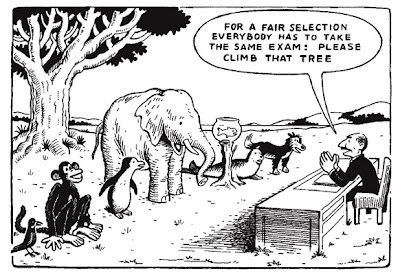
I don't know the answer. But while "standardized testing" has become an evil word in American education, we continue to use it, flaws and all. And the problem intensifies lower down in the socioeconomic food chain. At this point, you'd better hope you're a monkey.
“If I’d been required to take those two tests when I was a 10th grader, my life would almost certainly have been very different. I’d have been told I wasn’t ‘college material,’ would probably have believed it, and looked for work appropriate for the level of ability that the test said I had.
“It makes no sense to me that a test with the potential for shaping a student’s entire future has so little apparent relevance to adult, real-world functioning. Who decided the kind of questions and their level of difficulty? Using what criteria? To whom did they have to defend their decisions? As subject-matter specialists, how qualified were they to make general judgments about the needs of this state’s children in a future they can’t possibly predict? Who set the pass-fail 'cut score'? How?”
“I can’t escape the conclusion that decisions about the [state test] in particular and standardized tests in general are being made by individuals who lack perspective and aren’t really accountable.”
In a nutshell:

I don't know the answer. But while "standardized testing" has become an evil word in American education, we continue to use it, flaws and all. And the problem intensifies lower down in the socioeconomic food chain. At this point, you'd better hope you're a monkey.
Thursday, November 3, 2011
"N" for Knowledge

Nine hours there. Nine hours back.
My last road trip of the 2011 Wildcat football season begins tomorrow. My friends and I are caravaning from Chicago, Illinois to Lincoln, Nebraska, to watch Northwestern's first bout against Nebraska, the newest member of the B1G. Bring it on, Cornhuskers.
Tuesday, November 1, 2011
The Meaning of Life, according to A.C. Grayling

A.C. Grayling has rewritten the Bible. He's pretty confident in his opinions.
Photo via The Guardian.
In five minutes, philosopher A.C. Grayling offers an insightful and compact meditation on the meaning of life. Watch the video here. (I really wish I could embed the video, but alas, it's hosted on the New York Times website.)
If you're not convinced, here's an excerpt that gets to the heart of imbuing life with meaning and perspective: "It's up to you...Find something. Create something. Recognize the profoundly palliative character of love, of the human affections and friendship. And live with dignity. And when you do this, you find something -- and it sounds very simple and very glib but it's true -- that the meaning of life is to make life meaningful. That's a responsibility you have."
(You really should click through and watch the video, to get the full effect. Link again.)
His words remind me of a favorite quote from Annie Dillard: "How we spend our days is, of course, how we spend our lives." It seems so simple, but it can be hard, at the end of a long day, to cherish every moment, to steep the passing hours in significance, to do something other than collapse on the couch after work or class or rehearsal and watch bad reality TV while eating Nutella with a spoon, directly from the container. It's hard to feel as though one's accomplished work is enough. To reach beyond what's expected. It's easier to settle. To become anesthetized. To lose fire and passion. Are these not the individual's private philosophical concerns, the gateway drugs to depression and isolation? Humans weren't meant to be alone or depressed; we were meant to thrive and explore, to make connections.
Or maybe our purpose was to create the Internet, so that we could all post pictures of our cats, and then in 2012 the Internet will open up, screaming like a banshee, and swallow us whole, starting with the U.S. (including Alaska and Hawaii) and quickly followed by the rest of the northern American continent. South America will go next, hinged on the Panama Canal and unable to resist the pull of North America toward the depths of the earth. Europe, Africa, Asia, and Australia will eventually crumble and be engulfed. Greenland will meander, trying to dissociate itself from the real continents, but the sinkhole will get it eventually, submerging it, forcing it beneath the surface. Various island chains will be the last to go before the earth is left desolate, destroyed by our obsession with anthropomorphizing cats for not only Halloween, but every other day of the year too. Only Antarctica, a place that has never seen cats, will survive. A refugee camp will be established, and the human race will rebuild--
What? Cats have been visiting Anarctica since right after WWII? Well fuck. We're doomed.
Friday, October 7, 2011
Stephen Fry: "Context, convention and circumstance are all."
I am officially obsessed with this media form -- that is, typographic animation set to spoken word. And I love that it's so self-referential, that the language-benders are bending language to demonstrate how great language can be when bent.
A lot of my writing time lately has been spent on offline projects. I'll poke my head out on this and the other active blog I've working on right now, but fall always seems to snag me with a huge amount of work. But it's my last quarter as a full-time grad student, so I'm dedicating myself to a new form of caffeine (hello, coffee) and buckling down. But this video and others like it will be my study breaks, to remind me of why I'm doing it all.
A note on the video itself: I love that Stephen Fry distinguishes between lovers of language and the people who are annoying about it and ruin it for everyone. I often find myself frustrated with often-misused words (like the difference between "over" and "more than"), but I am reminded that language evolves, it belongs to no one, and it's no use to squabble over the small distinctions, especially in contexts where other aspects (like substance) are more worthy of focus. The crux of it is here: "Nor does the idea that following grammatical rules in language demonstrates clarity of thought and intelligence of mind." Grammar is a tool we use to communicate effectively, but it is not a mastery of grammar that signals achievement: You still need something substantive to say.
At the same time, grammar is important because, as Stephen Fry says, ignoring it gives the impression that you don't care. "You slip into a suit for an interview, and you dress your language up too." And so while mastering grammar is not the end-all means to achieve good writing, it's still necessary to understand it. It's the framework we've created as a culture, the test to pass to prove you understand not only what to say, but how to say it. "You can wear what you want linguistically and sartorially when you're at home or with friends, but most people accept the need to smarten up under some circumstances. It's only considerate. But that's an issue of fitness, of suitability. It has nothing to do with correctness. There's no right language or wrong language any more than there are right or wrong clothes. Context, convention and circumstance are all."
Hear hear!
Thursday, September 29, 2011

Wednesday, September 28, 2011
How to Ride a Bike
Dear Marianne Chrisos,
I was recently informed that you've forgotten how to ride a bike. You learned, but then you forgot, and you'd like to remember, to recall what it feels like to ride, the sensation. Here's what I offer:
Riding a bicycle is like playing a video game in real life. Chicago, specifically the North Shore, is fantastic for this. You choose the terrain: urban city streets, lakefront beach, the grassy knolls of Lake Shore and Lincoln Park. You choose day or night, heavy traffic or light. You can compete with those around you or just yourself. You can time it, or ride a certain number of miles, or just get on the bike and go. I like having a destination, something farther away, a few miles maybe, so I can feel my heart pumping and my skin heating up. I like riding in the cool fall, crunching through leaves, manually warming up my body, watching my own breath hit me in the face.
You start slow, rolling the bike for a few steps in the driveway, until you stop and swing your leg over. You put your right foot on its corresponding pedal and push down, lifting the other leg off the ground and finding balance as the wheels roll forward, taking you with them. Before you lose momentum, you put your left foot on the other pedal and push again, and then again with your right, and then again with your left. You may wobble for a minute, which is what the training wheels were for on your first bike, but you have a lower center of gravity now. Being short and female is helpful in that regard.
It's true, your butt hurts more on a real bike than on the video game bike. But that's okay because you're earning it. Once you get moving, you feel the wind in your hair and smell whatever season has crept over Lake Michigan. I like riding on rainy days because the air is cleanest and smells like laundry detergent designed to smell like fresh air. I also like riding on rainy days because it makes me feel like a badass. I ride harder and faster, feeling my heart quicken and my thighs ache as I push right, left, right, left, over and over, dodging raindrops. I stand up and push down with my body weight on the pedals to go faster, to keep up with the cars on Halsted Street. They usually pass me, but during rush hour I can easily outstrip an entire line from Wellington to Fullerton.
I pedal so hard that I arrive at my destination exhausted, in need of refreshment. Local tea and soup sales go up exponentially as cold weather grips the city and cyclists suffer runny noses and inclement weather. It's only September, but I've already bought enough hot beverages to pay for a new branch of a needlessly expensive coffee chain. (To whom it may concern: Corner of Sheridan and Irving Park, please. And make it snappy. Winter's coming.)
Once you work up some speed on the bike, or if you're on your way home at the end of a long day, you may choose to stop pedaling and drift. I wear a hat and gloves, and I sit up and take one hand off the handlebars, stretching my back up straight, watching my fellow urbanites or the city skyline to the south. Sometimes I stick my legs out to the side, brushing the grass or the puddles beneath me. If I ride through a big puddle, I bend my knees to lift my shoes up out of the water's spray, squealing involuntarily. I try not to splash runners or fellow bicyclists. They're already soaking wet, though, so it really doesn't make a difference except that it makes me look like a jerk for splashing them with more frigid water.
I would be remiss if I described the joys but did not outline the rules of the road. We're in America, so ride on the right side. We're in a major metropolis, so ride in the street, not on the sidewalks. Beware of turning vehicles, parked vehicles, and all vehicles. Put a white flashing light on the front of your bike and a red flashing light on the back, and tuck in your right pant leg so it doesn't get caught in the gears. (Getting tangled up is an unpleasant experience, especially in the middle of the Clark/Halsted/Barry six-way intersection.) And since there may be kids reading, wear a helmet.
So, want to go for a ride sometime?
I was recently informed that you've forgotten how to ride a bike. You learned, but then you forgot, and you'd like to remember, to recall what it feels like to ride, the sensation. Here's what I offer:
Riding a bicycle is like playing a video game in real life. Chicago, specifically the North Shore, is fantastic for this. You choose the terrain: urban city streets, lakefront beach, the grassy knolls of Lake Shore and Lincoln Park. You choose day or night, heavy traffic or light. You can compete with those around you or just yourself. You can time it, or ride a certain number of miles, or just get on the bike and go. I like having a destination, something farther away, a few miles maybe, so I can feel my heart pumping and my skin heating up. I like riding in the cool fall, crunching through leaves, manually warming up my body, watching my own breath hit me in the face.
You start slow, rolling the bike for a few steps in the driveway, until you stop and swing your leg over. You put your right foot on its corresponding pedal and push down, lifting the other leg off the ground and finding balance as the wheels roll forward, taking you with them. Before you lose momentum, you put your left foot on the other pedal and push again, and then again with your right, and then again with your left. You may wobble for a minute, which is what the training wheels were for on your first bike, but you have a lower center of gravity now. Being short and female is helpful in that regard.
It's true, your butt hurts more on a real bike than on the video game bike. But that's okay because you're earning it. Once you get moving, you feel the wind in your hair and smell whatever season has crept over Lake Michigan. I like riding on rainy days because the air is cleanest and smells like laundry detergent designed to smell like fresh air. I also like riding on rainy days because it makes me feel like a badass. I ride harder and faster, feeling my heart quicken and my thighs ache as I push right, left, right, left, over and over, dodging raindrops. I stand up and push down with my body weight on the pedals to go faster, to keep up with the cars on Halsted Street. They usually pass me, but during rush hour I can easily outstrip an entire line from Wellington to Fullerton.
I pedal so hard that I arrive at my destination exhausted, in need of refreshment. Local tea and soup sales go up exponentially as cold weather grips the city and cyclists suffer runny noses and inclement weather. It's only September, but I've already bought enough hot beverages to pay for a new branch of a needlessly expensive coffee chain. (To whom it may concern: Corner of Sheridan and Irving Park, please. And make it snappy. Winter's coming.)
Once you work up some speed on the bike, or if you're on your way home at the end of a long day, you may choose to stop pedaling and drift. I wear a hat and gloves, and I sit up and take one hand off the handlebars, stretching my back up straight, watching my fellow urbanites or the city skyline to the south. Sometimes I stick my legs out to the side, brushing the grass or the puddles beneath me. If I ride through a big puddle, I bend my knees to lift my shoes up out of the water's spray, squealing involuntarily. I try not to splash runners or fellow bicyclists. They're already soaking wet, though, so it really doesn't make a difference except that it makes me look like a jerk for splashing them with more frigid water.
I would be remiss if I described the joys but did not outline the rules of the road. We're in America, so ride on the right side. We're in a major metropolis, so ride in the street, not on the sidewalks. Beware of turning vehicles, parked vehicles, and all vehicles. Put a white flashing light on the front of your bike and a red flashing light on the back, and tuck in your right pant leg so it doesn't get caught in the gears. (Getting tangled up is an unpleasant experience, especially in the middle of the Clark/Halsted/Barry six-way intersection.) And since there may be kids reading, wear a helmet.
So, want to go for a ride sometime?
Sincerely,
Brittany Petersen
Sunday, September 25, 2011

Subscribe to:
Posts (Atom)